DAVOS ALZHEIMER’S COLLABORATIVE HIGHLIGHTS GLOBAL ADVANCES IN DETECTION, INCLUSIVE COHORT RESEARCH, AND HEALTH SYSTEM READINESS AT AD/PD 2026
Teams Expand Dementia Research Across Africa, Share New Evidence on Digital Cognitive Tools, Sensory Assessments, and Real-world Diagnostic Implementation
CONTACT: Daphne Wong, inquiry@davosalzheimerscollaborative.com
COPENHAGEN (March 11, 2026) – The Davos Alzheimer’s Collaborative (DAC), a worldwide initiative accelerating innovation in Alzheimer’s disease research and care, will present new findings and implementation outcomes at the 2026 International Conference on Alzheimer’s and Parkinson’s Disease and Related Neurological Disorders (AD/PD) in Copenhagen, Denmark. These findings include new insights and data from the Healthcare System Preparedness and Global Cohorts programs. Learnings will be shared through posters, oral abstracts and presentations, and a sponsored symposium.
HEALTHCARE SYSTEM PREPAREDNESS
DAC’s Healthcare System Preparedness (DAC-SP) Program catalyzes global healthcare system transformation allowing patients and their families quicker access to life-changing innovations. Initiatives spanning early detection and accurate diagnosis programs include 70+ healthcare system sites across 19 countries in 5 continents.
At AD/PD, DAC-SP will spotlight emerging learnings through:
A poster presentation (#01-442, March 17th) on the Accurate Diagnosis program, launched in eight sites across five countries to implement blood biomarker (BBM) and confirmatory Alzheimer’s pathology testing into primary and specialty care for timely and accurate diagnosis of Alzheimer’s disease and related disorders.
A DAC/CEOi sponsored symposium - Blood Biomarkers: A Completed Chapter or Work in Progress? Practical Challenges and Solutions for Real-World Implementation (March 20th, Hall A1) - where Phyllis Barkman Ferrell, DrPH, MBA, DAC Advisor and Ben Tiede, PhD, Executive Director of the Global CEO Initiative on Alzheimer’s Disease, will convene global experts to identify actionable solutions that can accelerate the translation of BBMs from research settings into routine clinical care, ultimately benefiting patients and families affected by Alzheimer's disease worldwide. Expert panelists include: • Greg Cooper, MD, PhD • Atsushi Iwata, MD, PhD • Michelle M. Mielke, PhD • Sebastian Palmqvist, MD, PhD • Suzanne E. Schindler, MD, PhD • Charlotte Teunissen, PhD • Henrik Zetterberg, MD, PhD
For more information on DAC Healthcare System Preparedness presentations contact Medical Affairs Lead: Katie Selzler, PhD.
GLOBAL COHORTS
DAC’s Global Cohorts Program now includes 7 cohorts around the world, including Kenya, South Korea, the Caribbean, Egypt, India, Chile, and Malaysia. At AD/PD, DAC will spotlight research findings from several global sites.
Posters include:
A Latin America–based study exploring smartphone‑based cognitive monitoring and its associations with standard cognitive screening tools in older adults.
Qualitative insights from Malaysia capturing older adults’ perspectives on smartphone‑based cognitive screening in low‑ and middle‑income settings
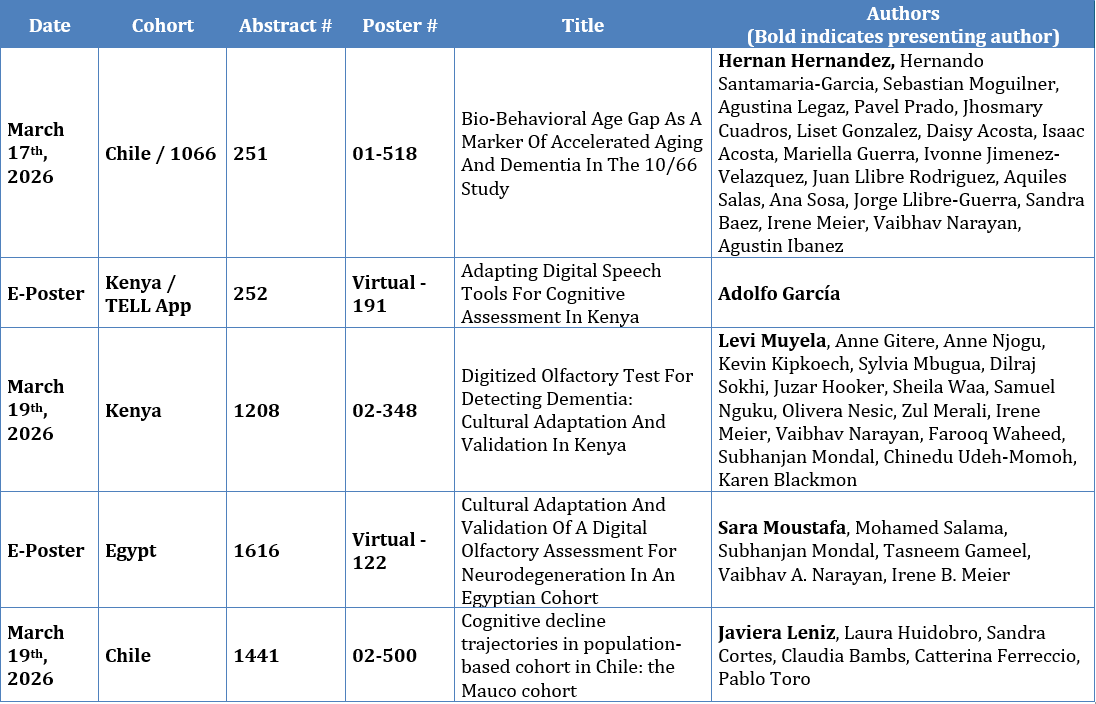
Research from Latin America examining bio‑behavioral age gaps as a marker of accelerated aging and dementia risk.
Findings from Kenya on adapting digital speech‑based tools for culturally relevant cognitive assessment in local populations.
Results from Kenya on the cultural adaptation and validation of a digitized olfactory test for detecting dementia.
An Egyptian cohort study focused on adapting and validating a digital olfactory assessment for neurodegeneration in a local cultural context.
Findings from Chile linking subjective cognitive complaints and baseline cognition to subsequent cognitive decline in a population‑based middle‑aged and older cohort.
For more information on DAC Cohorts presentations or to request interviews with researchers, contact Executive Director, Program Strategy and Operations: Irene Meier
ABOUT THE DAVOS ALZHEIMER’S COLLABORATIVE
The Davos Alzheimer's Collaborative (DAC) is a pioneering worldwide initiative to end Alzheimer’s disease and improve brain health, seeking to mirror the success of global efforts against infectious diseases. DAC is extending global research beyond its current focus on traditional Western European ethnic populations into the highly diversified populations of the Global South, where the vast majority of those with Alzheimer’s live. By introducing lower-cost screening and diagnostic tools as well as new treatment and prevention modalities in primary care and community health settings, DAC is driving implementation of health system solutions that are appropriate for worldwide application. DAC also promotes the vital importance of brain health throughout the lifespan by addressing cardiometabolic and lifestyle factors, especially in early and mid-life. Absent effective action at scale around the world, by 2050, more than 150 million families and half a billion people will be personally impacted by dementia, creating a social, financial, economic, and global security disaster of historic proportions. DAC was launched in Davos in 2021 by the World Economic Forum and the Global CEO Initiative on Alzheimer's Disease. For more information, please visit: davosalzheimerscollaborative.org.
DAC Global Cohorts
ORAL PRESENTATIONS
Neuroimaging correlates and diagnostic performance of a fully automated plasma ptau217/aβ42 ratio assay in a clinical cohort with Alzheimer’s Disease
Cohort: South Korea
Date, Time & Location: Saturday, March 21st - 11:25 - 11:40
Authors: Yoo Hyun Um, Paul Wynveen, Mark Holland, Kinal Bhatt, Zivjena Vucetic, Corey Carlson, Irene B. Meier, Vaibhav A. Narayan, Sheng-Min Wang, Dong Woo Kang, Sunghwan Kim, Suhyung Kim, Donghyeon Kim, Yeong Sim Choe, Regina E. Kim, Seunggyun Ha, Hyun Kook Lim
ORAL ABSTRACTS
Older Adults’ Digital Reflections On Smartphone-Based Cognitive Screening: A Qualitative Study In Low And Middle-Income Countries
Cohort: Malaysia
Authors: Roshaslina Rosli, Tan Maw Pin, Nur Samihah Abdullah, Nor Fazlin Zabudin, Khailesh Bushan Balakrishnan
Smartphone-Based Cognitive Monitoring: Associations With Moca And Vcat In Older Adults
Cohort: Malaysia
Authors: Nur Samihah Abdullah, Roshaslina Rosli, Tan Maw Pin, Muhammad Harith Pukhari, Sobiitraa Devii Kumanan, Chong Chee Ning, Nor Fazlin Zabudin
POSTER PRESENTATIONS
DAC Healthcare System Preparedness
POSTER PRESENTATION:

DAC/CEOi SPONSORED SYMPOSIUM:
Blood Biomarkers: A Completed Chapter or Work in Progress? Practical Challenges and Solutions for Real-World Implementation
Date, Time & Location: Friday, March 20th, 2026 | 08:40 - 10:40am | Room: Hall A1
Session Moderators: Phyllis Ferrell, DrPH, MBA and Ben Tiede, PhD
Speakers: Greg Cooper MD, PhD, Norton Neuroscience Institute; Atsushi Iwata, MD, PhD, Tokyo Metropolitan Institute for Geriatrics and Gerontology; Michelle M. Mielke, PhD, Wake Forest University School of Medicine; Sebastian Palmqvist, MD, PhD, Skåne University Hospital, Lund University; Suzanne E. Schindler, MD, PhD, Washington University School of Medicine; Charlotte Teunissen, PhD, Amsterdam University Medical Center; Henrik Zetterberg, MD, PhD, University of Wisconsin-Madison, University College London; University of Gothenburg
Session Description: Recent dialogues, notably at previous scientific congresses, have highlighted that blood biomarkers (BBMs) for Alzheimer's disease are scientifically ready and well positioned for broader implementation. However, significant operational, clinical, and policy barriers remain and still need to be addressed. The Davos Alzheimer's Collaborative Healthcare System Preparedness Program (DAC-SP) is collecting real-world implementation data of BBM assays across the diagnostic pathway in multiple healthcare systems globally. Concurrently, the Global CEO Initiative for Alzheimer's Disease (CEOi) has been deeply engaged in driving consensus recommendations among cross-sector experts and educating providers to accelerate BBM adoption.
Building on the foundation established by the DAC-SP's global implementation data and CEOi's alignment efforts, this two-hour symposium session provides a critical opportunity to bridge the gap between scientific readiness and real-world deployment of BBMs for Alzheimer's disease. This session is intended to foster an environment of transparent dialogue where academic researchers, clinical practitioners, and implementation specialists can share their experiences navigating the complex landscape of BBM integration into existing healthcare systems. Through this collaborative exchange, panelists identify actionable solutions that can accelerate the translation of these promising diagnostic tools from research settings into routine clinical care, ultimately benefiting patients and families affected by Alzheimer's disease worldwide.